
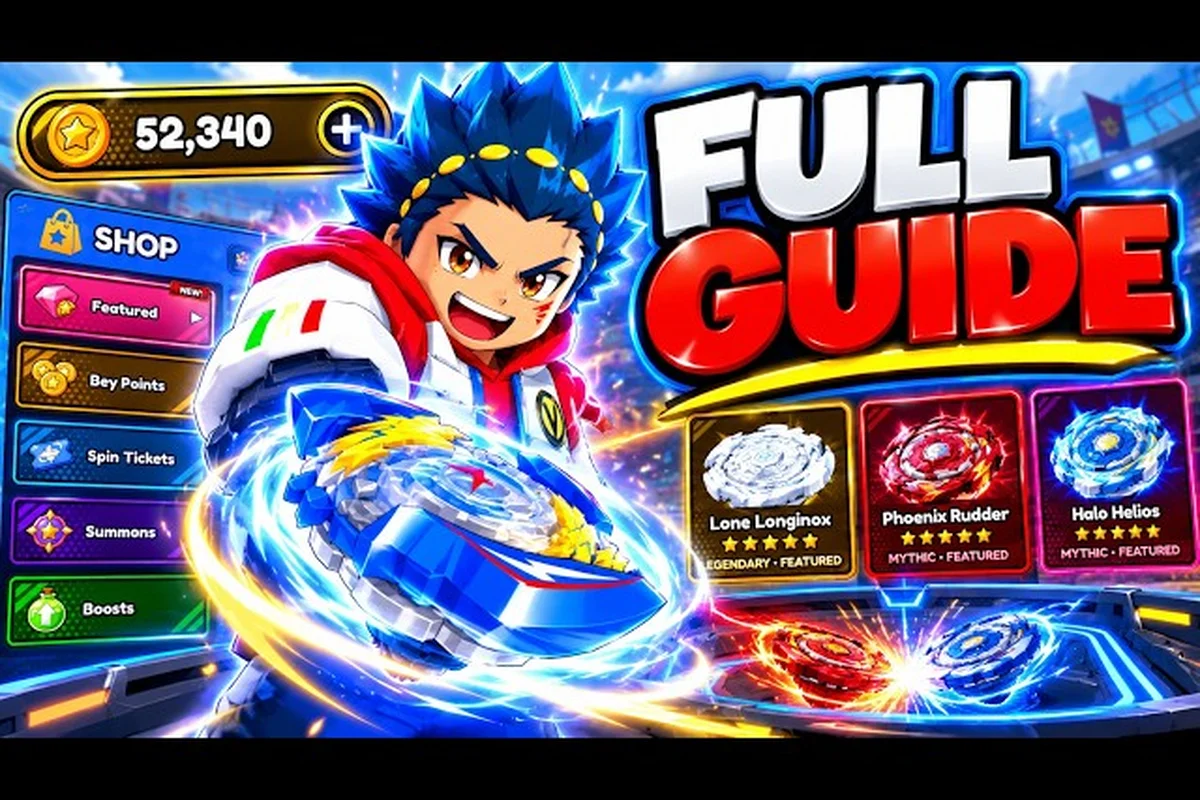
Bey Rivals banner parts are the rotating pool of components you roll for with Spin Tickets, Lucky Spins, and Soul Tickets, and they decide whether your build leans into burst pressure or long-spin survival. Understanding how event parts, Halloween parts, and limited parts cycle in and out keeps you from wasting rolls on a banner that no longer drops what you need.
How Banner Parts Drive the Customization Loop
Every blader in Bey Rivals launches a custom Bey into the arena and wins by burst-popping or ringing out the opponent, so the parts you equip matter more than raw playtime. Banner parts are the main obtainable pool, and the game sorts them into four functional types that shape how your Bey behaves in a clash.
-
Attack parts push aggressive burst pressure, ideal for finishing clashes fast.
-
Defense parts trade offense for durability, helping you survive heavy hits.
-
Stamina parts extend spin time so you outlast opponents in long exchanges.
-
Balance parts blend stats, giving hybrid builds a flexible middle ground.
Rarity scales from Common through Epic, Legendary, and Mythic, and higher-rarity parts generally carry stronger base stats. That progression is why players chase Legendary parts and Epic parts specifically, since a single high-rarity layer or driver can shift a build from "usable" to "ranked-ready." The game launched in the October 2026 window, and frequent balance patches mean the meta shifts quickly, so a part that dominated last week may already be re-tuned.
Part stats and quality are visible directly in your inventory, which lets you compare a fresh roll against what you already own before committing resources. Because official numerical tier lists are not published, most build decisions rely on community-tested values rather than a developer-supplied ranking.
Reading Part Stats Before You Roll
The inventory screen shows each part's stats and quality, so the smart habit is to check what you already have before spending Lucky Spins on a banner. If a banner's featured part duplicates a slot you have already filled with a stronger piece, the roll is low value even if the rarity looks exciting. Community guides consistently recommend evaluating the whole loadout—four rolling parts plus a Bey identity—rather than chasing one flashy drop.
Event Parts, Halloween Parts, and Seasonal Windows
Seasonal banners are where limited-event parts enter the game, and the Halloween-style window is the clearest example of how this works. During that promo period the title even carries a pumpkin emoji prefix, signaling that event parts and Halloween parts are live in the rotation. These seasonal additions are time-gated: once the banner rotates out, the featured parts stop dropping from the standard pool.
The key distinction is that legacy and limited parts remain equippable after their banner leaves. You do not lose a part when the event ends—you simply cannot roll for it anymore through that banner. That single rule changes how you should plan your tickets, because a part you skip during its window may become much harder to obtain later.
| Banner State | What Drops | Can You Still Equip It Later? |
|---|---|---|
| Standard rotation | Main pool parts across all rarities | Yes |
| Seasonal event window | Featured event parts plus returning parts | Yes |
| Halloween promo | Halloween parts and limited-event additions | Yes |
| Post-rotation | Featured parts removed from pool | Yes, if already owned |
Returning parts do rotate back into banners, so a missed drop is not always gone forever, but the timing is unpredictable. Players who track which parts they still need—rather than rolling reactively—tend to fill gaps faster. For a broader look at how seasonal and event Bey releases pair with these part windows, the event limited Beys list breaks down which collections are confirmed.
Why Timing Beats Raw Spending
Spin Tickets, Lucky Spins, and Soul Tickets all feed the same part-rolling economy, and each one is finite unless you keep earning more. That scarcity is the reason timing matters more than volume. Rolling heavily on a standard banner when a seasonal window is about to open means you may miss the limited parts entirely, then spend twice as much trying to catch up. Watching the banner rotation before you commit tickets is the single highest-value habit in this system.
Epic and Legendary Parts: What Rarity Actually Changes
Rarity is the headline number players chase, but it is worth being precise about what it does and does not do. Higher-rarity parts generally carry stronger base stats, which is why Legendary parts and Epic parts anchor most competitive builds. What rarity does not do is guarantee a part fits your type—a Legendary Attack layer on a Stamina-focused build can still underperform a well-matched Epic piece.
| Rarity | Typical Role in a Build | Roll Priority |
|---|---|---|
| Common | Early filler and budget setups | Low once you have better |
| Epic | Solid mid-tier stat anchor | Medium—fills gaps cheaply |
| Legendary | Strong base stats for ranked play | High when it matches your type |
| Mythic | Top-end stat ceiling | Highest, but rare |
Surnames and traits sit on top of this system as separate modifiers. Surnames are family-line buffs that community reports describe as independent of part stats and rarity, while the Trait Lab lets you assign traits that change how a part behaves. That means two players can own the same Legendary part and still get different results depending on surname and trait choices.
Surname and Trait Layers
Because surnames and traits stack on top of base stats, a part's real value depends on how you configure it. A high-rarity part with a mismatched trait can underperform, while a modest part with the right surname buff can punch above its weight. Community build advice treats these as a package: pick the part for its type and stats, then tune the trait to match your win condition. The rarest soul traits breakdown digs into how these modifiers interact with banner drops.
Managing Duplicates With Autosell Rules
Long rolling sessions produce a flood of duplicate parts, and the autosell system exists to protect your inventory from clutter. Autosell rules automatically sell duplicate parts that meet thresholds you set, which keeps your inventory clean while you chase a specific drop. Setting these thresholds properly is a small decision with a large payoff.
-
Set autosell to keep only parts above a rarity floor you actually use.
-
Exclude your current build's part types so you never auto-sell a needed piece.
-
Review thresholds after each balance patch, since buffs and nerfs shift what is worth keeping.
-
Keep at least one copy of every limited part, even if it looks weak today.
The last point matters because legacy and limited parts stay equippable forever, and a future patch can turn a forgotten event part into a meta staple. Balance changes land frequently enough that "weak now" rarely means "weak forever." If a patch has recently shifted part values, the new parts update rundown tracks which buffs and nerfs changed the picture.
When to Hold Versus Sell
The practical rule is to hold anything you cannot re-roll easily and sell anything the standard pool drops constantly. Limited parts and event parts fall into the hold category because their banners may not return soon, while common duplicates from the main pool are safe to autosell. This keeps your inventory focused on parts that are genuinely hard to replace.
Building a Budget Loadout From Banner Drops
Not every player is swimming in Lucky Spins, and the good news is that a reliable build does not require top-rarity parts. Community guides describe a budget approach that pairs common and early parts with a Stamina or Balance driver to win consistently without spending premium rolls. The logic is simple: a long-spin driver lets you outlast opponents who built for burst but ran out of steam.
| Build Goal | Recommended Type | Why It Works |
|---|---|---|
| Win without premium rolls | Stamina driver | Outlasts burst builds |
| Balanced all-rounder | Balance driver | Flexible across matchups |
| Fast clash finishes | Attack layer | High burst pressure |
| Survive heavy hitters | Defense layer | Absorbs ring-out attempts |
The combat rules reward this patience because a Bey that burst-pops or is knocked out loses the clash outright. A Stamina-focused build that avoids both outcomes can grind out wins against flashier opponents. Once you have a stable budget setup, you can reinvest tickets into seasonal banners to upgrade individual slots rather than rebuilding from scratch.
Upgrading One Slot at a Time
The efficient path is incremental: keep your budget core intact and replace one part at a time as better drops arrive. Swapping a single slot lets you feel the difference immediately and revert if the change hurts. This is far safer than overhauling a whole loadout around an untested Legendary part, especially when balance patches are still moving the meta.
Checking Banner Status Before You Spend
Because banners rotate and patches land often, the final habit is verification. Before dumping tickets, confirm the current banner state, check whether a seasonal window is active, and review any recent balance changes that affect your target part. Server and update issues can also interrupt a rolling session, so it is worth checking status if something feels off.
-
Confirm which banner is currently active and what it features.
-
Check whether a seasonal or Halloween window is live.
-
Review recent buffs and nerfs for your target part type.
-
Verify your autosell thresholds will not delete a needed drop.
-
Keep one copy of every limited part you obtain.
This routine takes a couple of minutes and prevents the most common mistake in the part economy: spending premium tickets on a banner that no longer drops what you need. Players who verify first consistently report better roll efficiency than those who roll on impulse.
Frequently Asked Questions
Do banner parts disappear after an event ends?
No. Legacy and limited parts remain equippable after their banner leaves the rotation, so you keep anything you already own. What changes is availability—once the seasonal or Halloween banner rotates out, its featured parts stop dropping from the standard pool until they return in a future rotation.
Are Legendary parts always better than Epic parts?
Not automatically. Legendary parts generally carry stronger base stats, but a mismatched Legendary piece can underperform a well-fitted Epic part. Type match, surname buffs, and trait choices all influence real performance, so rarity is a starting point rather than a guaranteed upgrade for every build.
How should I set autosell rules for banner parts?
Set autosell to keep only parts above a rarity floor you actually use, and exclude your current build's part types so nothing needed gets sold. Always keep at least one copy of every limited part, since balance patches can turn a forgotten event drop into a meta staple later.
Can I get event parts without spending Lucky Spins?
Yes. Spin Tickets and Soul Tickets also feed the part-rolling economy, and community guides describe budget builds that win reliably using common and early parts. You can grind tickets through normal play and save premium rolls for seasonal banners where limited parts are actually featured.
Why do my part stats differ from another player's?
Surnames and traits stack on top of base stats, so two players can own the same part and get different results. Surnames act as family-line buffs independent of rarity, while the Trait Lab changes how a part behaves. Match both to your win condition for the best outcome.
Banner parts reward planning more than spending. Track the rotation, verify the active window before rolling, keep one copy of every limited drop, and build a stable budget core you upgrade one slot at a time—that combination keeps your Bey competitive through every seasonal shift.